






Up in flames…
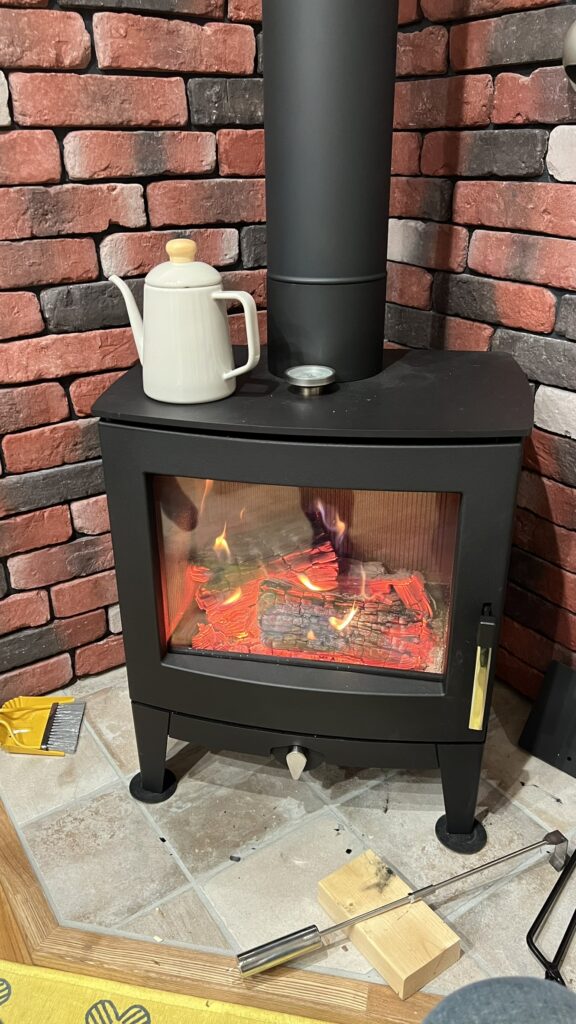
The wood stove briefing.
When I tell a new owner that walking them through the stove takes a long time, I usually get this look.
‘Huh? You just light it, right? I can look it up with AI.’
Quite right. You just light it. Look it up and you’ll get an almost correct answer.
Almost… mind you.
But what do you do if it over-fires and hits a temperature it should never reach?
What do you do if soot has built up and, right when the fire is burning beautifully, the tar in the chimney catches fire?
What do you do if air comes back down the chimney that is supposed to carry the smoke out, the stove backdrafts, and the glass is blown out?
Do you have time to ask ChatGPT?
A wood stove means lighting a bonfire inside your house. It is a dangerous thing to do.
Don’t take it lightly.
Take it lightly and you may end up half dead from carbon monoxide poisoning.
(It has actually happened where I live: a fashionable builder with half-baked knowledge nearly killed his client.)
Used properly, mind you, there is no heater as enjoyable, as rich, as cheap and as reassuring.
But a kitchen knife, a car: any tool will hurt you if you don’t learn to handle it.
The black stove in the photo is a Futura 5 from Stovax, a British maker. The white one in the video is a Dovre Vintage 50, a brand with Norwegian roots whose cast iron is poured in Belgium. Here is something people outside Japan may not know: to this day, in my view, not a single Japanese maker has managed to build a really good wood stove. Getting clean secondary combustion right seems to be very hard. So we rely on stoves from countries with a long history of making them. That is the reality in Japan, and it is why a British stove is seeing a Hokkaido house through the winter.
Now then…
There is an investment boom in Japan these days. The internet, the papers and the TV are noisy with who went up, who went down, who got rich and who went broke.
So, with 30 years of property investing and 20 years in the stock market behind me, I thought I would explain how to make it work.
Chapter 1: The danger of not knowing why it sold
When something doesn’t sell, people ask themselves ‘Why isn’t it selling?’ But when it is selling, hardly anyone asks ‘Why did it sell?’
I see it the other way round: the better things are going, the more careful you need to be. If you know why it sold, then when it stops selling you can tell what has changed. If you don’t, all you can do is wonder what went wrong.
I sold almost all my houses through my blog. 100 to 150 million yen a year. So I knew what to write to make them sell and what I could not leave out, and I wrote accordingly. When orders were piling up, I wrote unhinged posts to thin out the customers a little. When I wanted a few more, I ran a ‘nice guy campaign’. (In practice, doing the exact opposite sometimes sold and sometimes didn’t. (laughs)) I almost never had a time when houses weren’t selling, so I can’t talk too big, but whenever something felt slightly off I looked into what was wrong. Was it me, the world, or something else entirely?
That said, I didn’t understand any of this from the start. I started the company in November 1999 and the first five or six years went really well. But I thought that was probably just a honeymoon period for a newcomer. So in 2005 I started a blog.
Smartphones were nowhere yet. It was the age of the digital camera.
At the counter of my local izakaya, when the food arrived I would pull out a digital camera and take a picture. People stared at me as if I were very strange, and it was seriously embarrassing. Today’s YouTubers set up a tripod on the table and talk to their phone while they eat. I think it was about that level of embarrassment.
The blog took off. By the following year I had three years of work waiting. I knew the blog was doing it, but something felt wrong. Why would a silly blog like mine catch on? That was a real mystery to me. There was no way this could last…
It seems I’m the type who gets anxious when things go well. When things go badly, I think ‘Here we go!’ and perk up. Looking back, that temperament served me well.
There are 8 billion people in the world, and not one of them can read the future. Nobody knows what tomorrow brings. But I thought that just having a rough sense of which way things are heading would give me a lot of confidence. With that in mind, I opened a brokerage account in December 2006. That was the start of my investing. I wasn’t seriously trying to grow my money, and the amounts were tiny anyway…
Chapter 2: Stocks were my training in looking ahead
Selling houses is quite hard work, and knowing about houses is not enough. Interest rates, the economy, what to do when a disaster hits, lumber futures, how the building-material makers are doing…
To be continued.